The 2023 Climate Change Action Conference was held in Whangarei’s Forum North. About 200 delegates from all sorts of walks of life attended. The youngest being a few month new born to over 80 year old elders. The general spirit was very upbeat and positive. It felt that we need to change our narrative and words from Climate Change, Climate Crisis … to Climate Opportunities and how to Design/ Weave our Futures.
Did you attend the Tai Tokerau Climate Change – Action Conference? If you did … Whow, I don’t know how about you … but I am still buzzing. It was such a positive vibe in the room/s, people were so generous sharing knowledge, experiences, networks and weaving a joint fabric of “we can do this, let us work together”. Gone was the crisis aspect of Climate Change of previous events and discussions on the topic. My read was that people appreciate that there is something not quite right, that initially getting angry and complaining about it, getting frustrated or grieving is an important part of dealing with the enormity of the challenge and opportunity. But NOW is the time to ACT. All hands on deck and jointly stir the waka in one direction. The team of five million Kiwis can do it. And we will do it. In this post you find my personal and highly biased summary of the last two days with the most amazing kai (food) and people working on constructive solutions and deciding each of us what we are committing to…
Day 1 – Plenary sessions with Rereata Makihua, Peter Bruce, Nigel Meads, Glenn Edney, John Hamilton, Ayla Morris, Charles Buenconsejo (=good advice).
Day 2 – Workstreams I attended were Ocean Regeneration, EECA on SME support, Communication; Plenary: Wrap up, what was surprising, what new things did I learn, what am I doing now, what will I report back in the next month.
Day 1: The conference was appropriately kicked off by Hokianga Elder Rereata Makihu telling us about local wisdom. One story stuck particularly when several young Hapu members identified early warning signs from Pohutukawa tree blooms stretching South in November rather than North as is usual during that time of the year. Together with diligently observing these and other signs, they figured out in January 2023 that there would be a big weather event. They jumped into their dad’s ute and warned their whanaua close and far. When Cyclone Gabrielle hit Aotearoa 12. Feb 2022, they were prepared. The kaumatua also talked about maramatakua, polynesian navigation and the skill of stillness and observing early warning signals. Being prepared for the present and future is very important. I was thinking that teaching all of our tamaraki financial literacy on top of STEAM (science, technology, engineering, art, maths) helps to set them up to succeed in the Pakeha dominated western society. Of course this begs the questions of the “Limits to Growth” that the Club of Rome published in 1974 are finally getting recognized. And that growth for growth sake is not a sustainable and nice vision for the future.
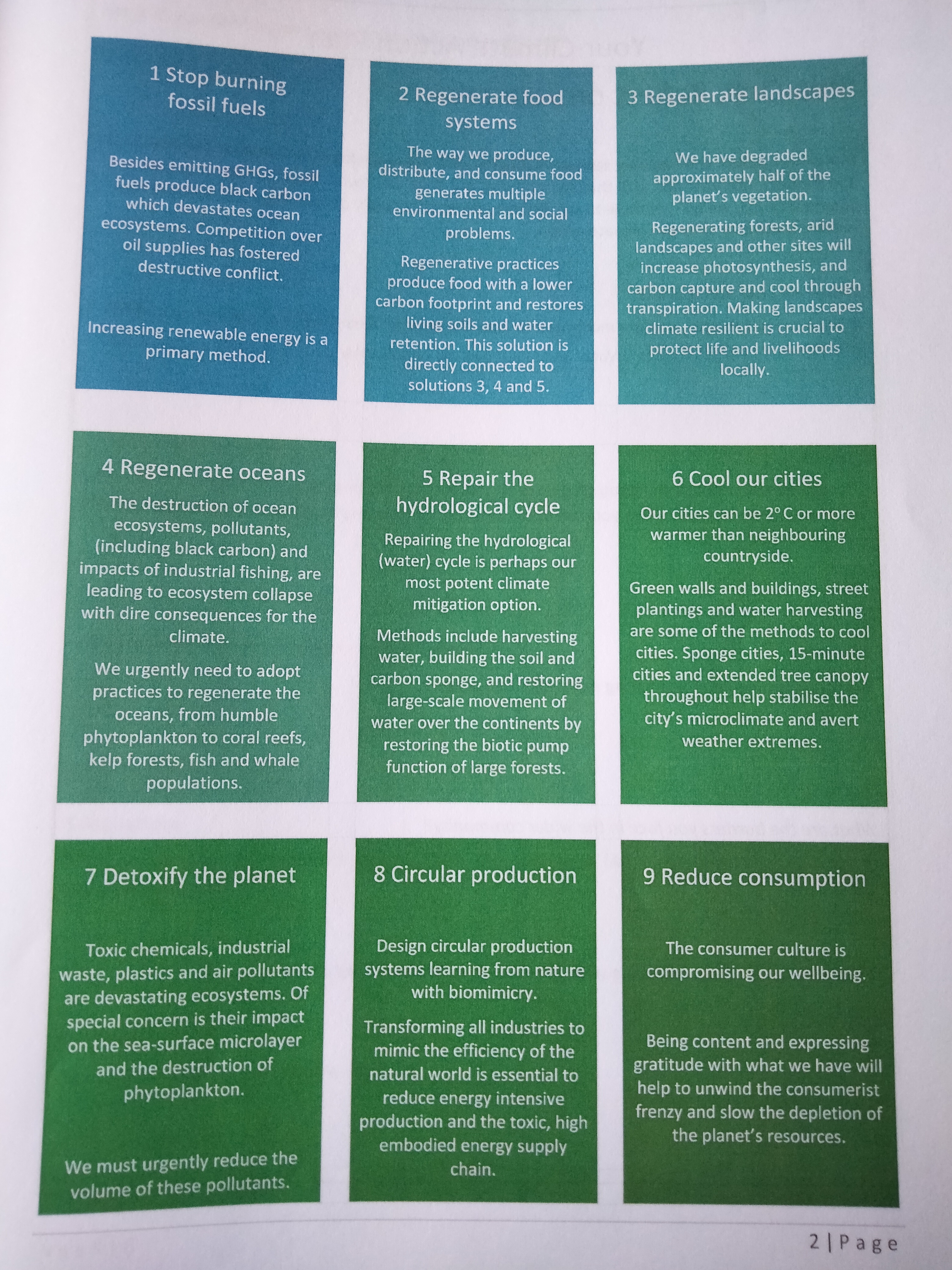
The main organizer Peter Bruce was the next speaker. Peter highlighted nine key areas relevant for impactful climate change action in Tai Tokerau. They include:
The third speaker was Nigel Meads from the privately held Irish company Alltech. They provide services to the livestock industry. Nigel talked about the need of good animal husbandry. And “you can’t be green, if you are in the red.” By better looking after your animals, it is good for the animal, the consumer and you. There were questions on the environmental impact on our waterways, methane production, fertilizer use. Nigel provided a positive outlook. Meriel Watts book “Poisoning of NZ” is important to consider to hold the balance. Martin mentioned the interesting work by Paul Behrens at Leiden University in the Netherlands. Paul’s talk on the “Good Food Transition” is thought provoking and positive.
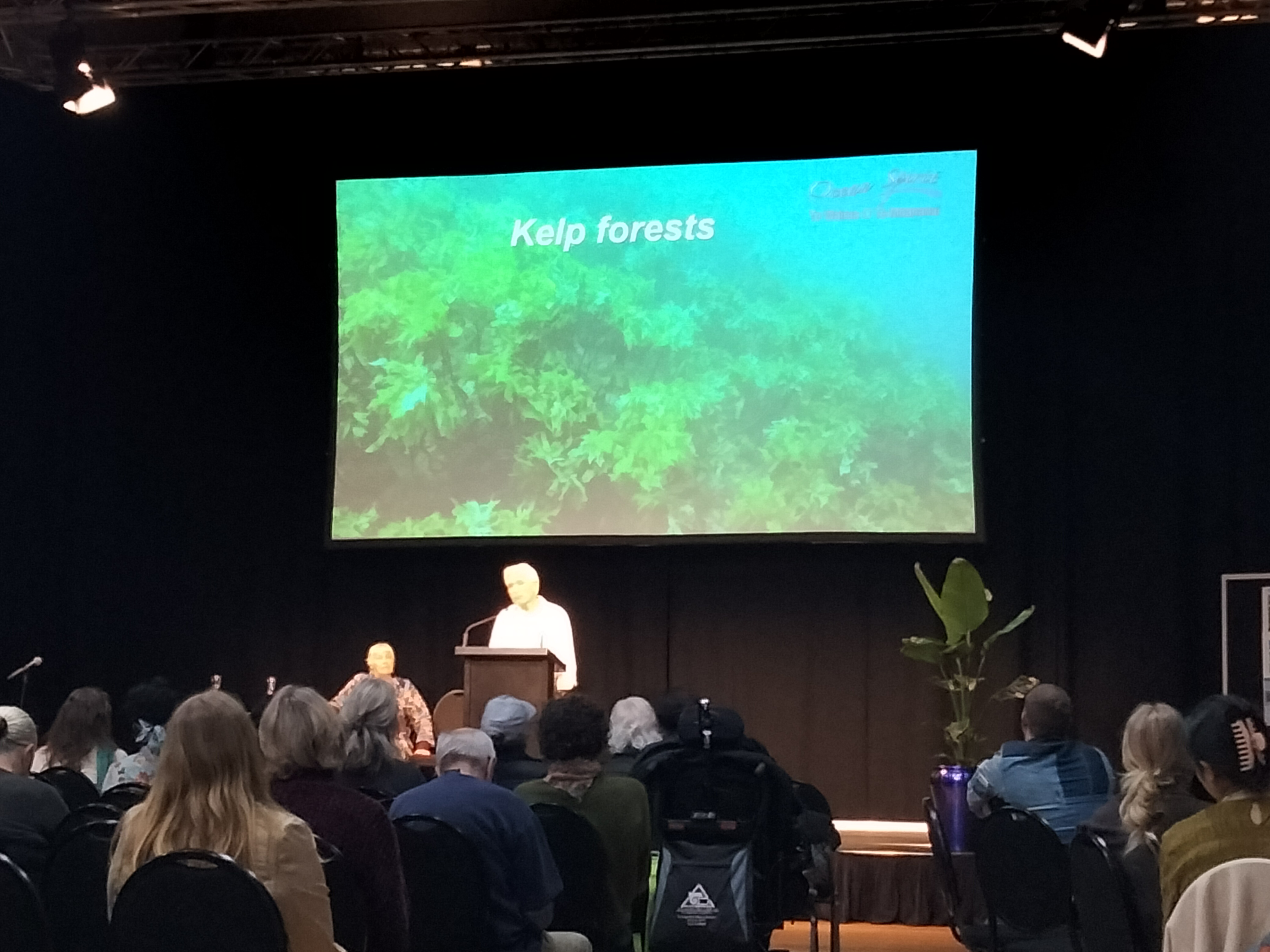
Glenn Edney provided a different definition what climate and weather is. Rather than “the behaviour of the atmosphere in a particular place over a longer (climate)/ shorter (weather) period of time”, he defines the climate as the “breath of mother earth”. You can find more details in his book “The Ocean is Alive”. Glenn explained the amazing kelp restoration project he runs with Hamish Clueard and the whanau around Church Bay on the Tutukaka Coast. In a nutshell, they are removing kina barrens (25 sqm area can have up to 3,000 kina. Due to rising water temperatures the predators who used to control kina numbers are gone and kina is eating kelp and other vegetation and leaving so called kina barrens. They were able to feed the whanaua for over 3 days with the kina the collected. The group than started to spawn kelp seedlings in a controlled environment in their onshore lab. Once the seedlings reached a certain size, they planted them in the old kina barren areas. Despite Cyclone Gabrielle hitting Tutuakaka Harbour only a few weeks after the planting, most of the seedlings were healthy and growing. Since then Hamish, Glenn and their team have had further kelp planting days. In addition to the water based work, they also started to re-swamp Hamish’s whanau land. The early settlers made the land ready for agricultural use like cattle. Now the team is turning the area back into its natural state. They are using best practices from South America and elsewhere to build several terraces to mimick the previous swamp state of the land. This filters the water before it gets into the harbour.
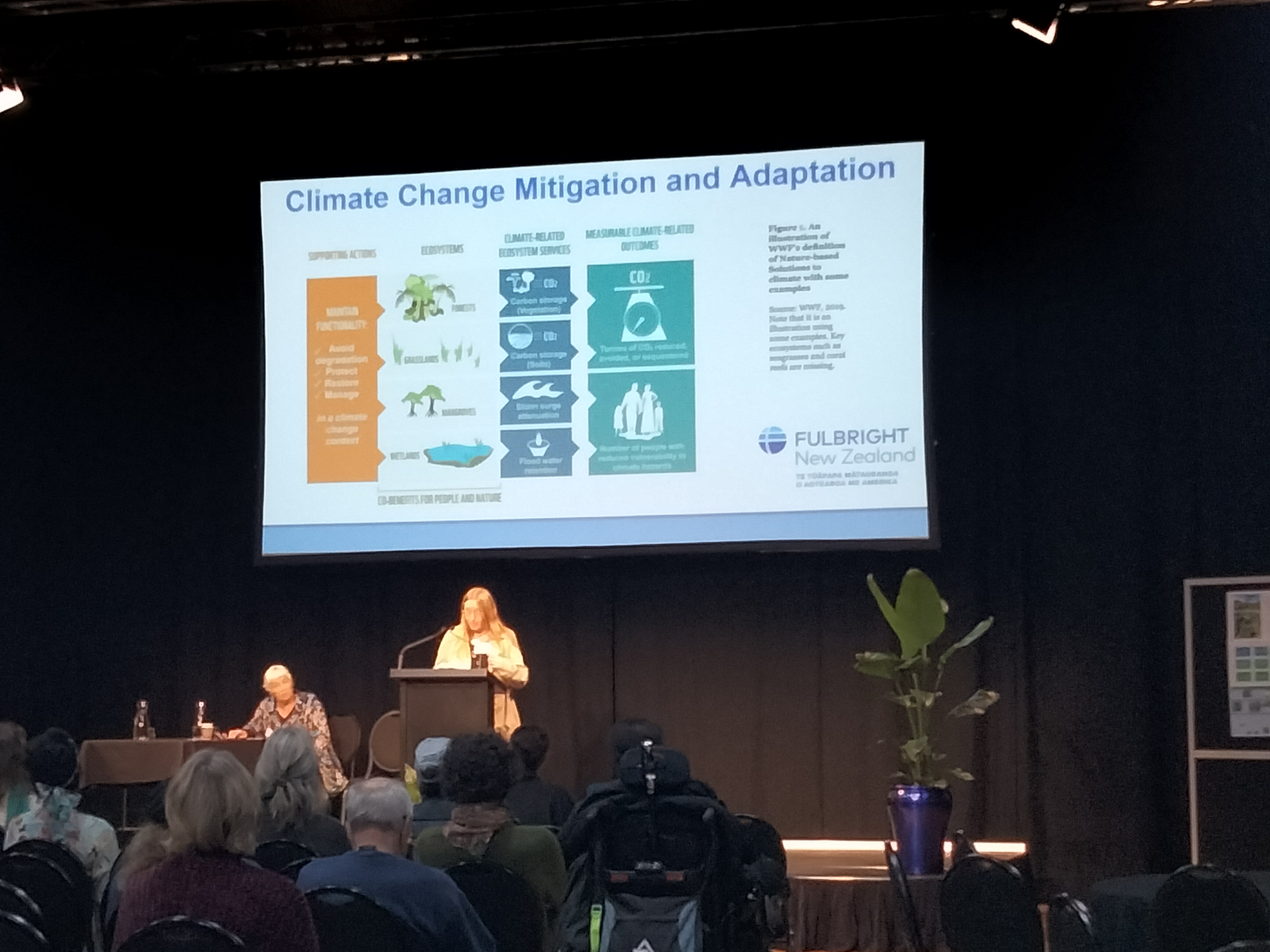
The Hokianga born Fullbright Student and Ministry of Internal Affairs team leader Alya Morris gave a fascinating talk about nature based solutions (NBS). This is in stark contrast to so-called geoengineering solutions. At Columbia University’s Climate School in New York she worked with her supervisor Paul Gallay. Alya shared her insights on how replace concrete sealed infrastructure with permeable structures, use green infrastructure like green roofs, rain gardens. In urban environments green and blue corridors, widening river flooding zones and riparian planting vs. building expensive houses (or schools like WBHS) in potential flooding zones. She also mentioned that often poorer neighbours are subject to less trees (cooling, air filtering), near industrial run offs like nuclear waste, Agent Orange waste (Hudson River area). After Superstorm Sandy hit NYC in 2012, the US Government kicked off Sandy+10 conference and a USD 61bn option to build man made structures for storm water, break water, artificial reefs and barrier islands, re-enforcing sand dunes instead of applying NBS options. If we are looking to the Netherlands which after the deadly floodings in the 1960s have built the most sophisticated dyke system on the planet, even there is talk about parts of the 18 million population having shift from near coast in the west to the east in this decade. Please note that the Netherlands has about the size of Northland and that 26% of it is below sea level. The deepest point being -6.7m. Northland coastlines could benefit from NBS rather than artificial and expensive industrial style engineering solutions. A case in point is Matapouri, where human sand movements after a few major storms lead to walkway bridges leading into nirvana. Alya also stressed that it is important to measure what matters not what a (possibly outdated) plan says.
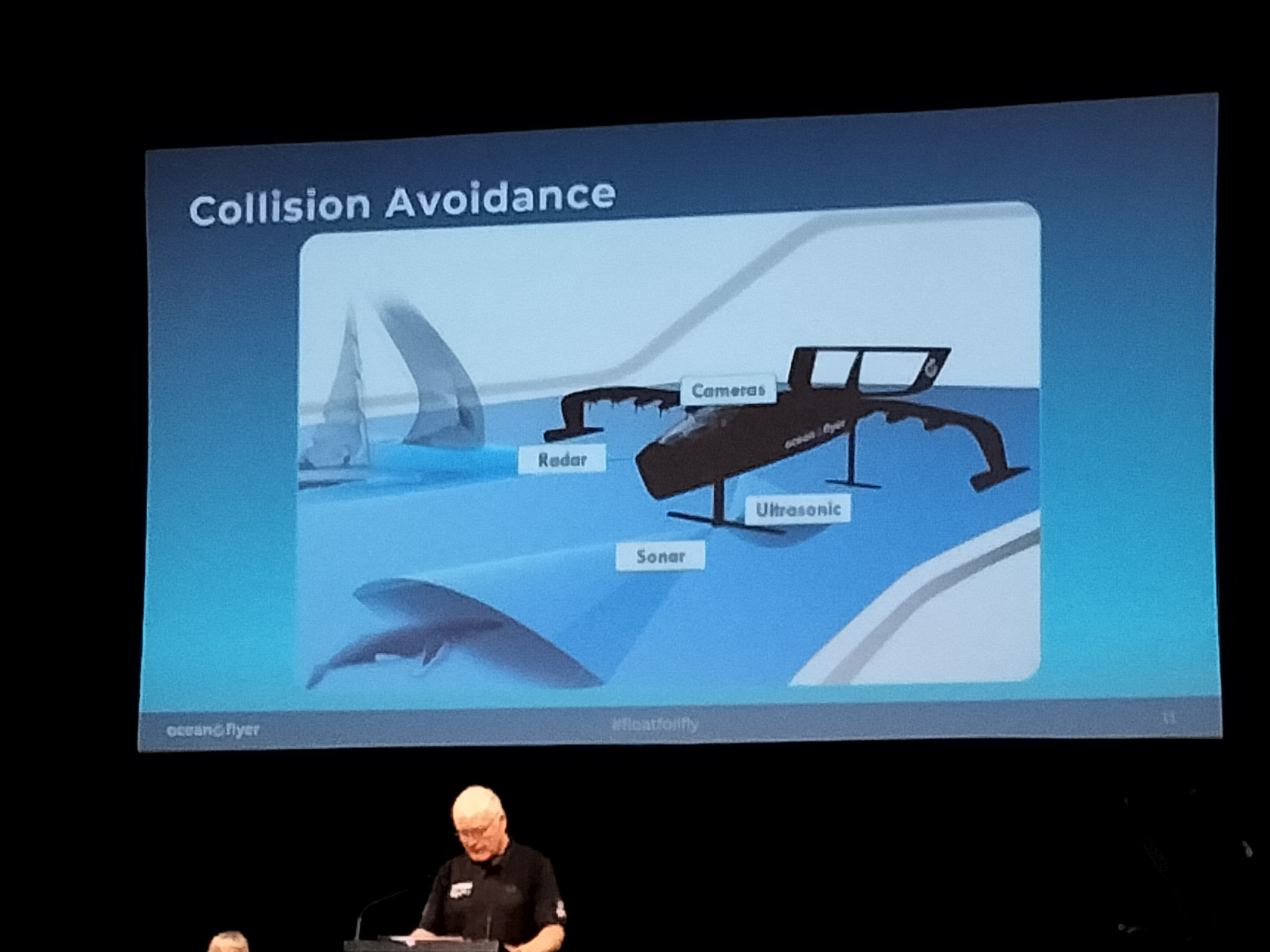
Next up was helicopter pilot and former marine John Hamilton from OceanFlyer. He talked about a new way of coastal transport. He is suggesting that the design of the Rhode Island innovator Regent will come to Aotearoa in 2026. John suggests that the 20 x 20m 12 seater will be able to transport people from Northport in Marsden Point to downtown Auckland in 35 minutes and for about $60 per person. The Seaglider would fly at about 10m above the water on foils. Northland is likely to be the first location for Oceanflyer (that is the NZ name of the Seaglider offering company founded by John). After that further point-to-point (P2P) flights could be offered. This would alleviate the need for people having to drive 2.5-3hrs to Auckland. The 1,600kg heavy Seaglider would potentially remove the carbon equivalent of 550 cars or 10 trucks of the road (not sure if I got these figures quite right). Since they are flying with 12 electric motors, each can be easily lifted by one person, and powered by renewable electricity, it could be an interesting future transport alternative.
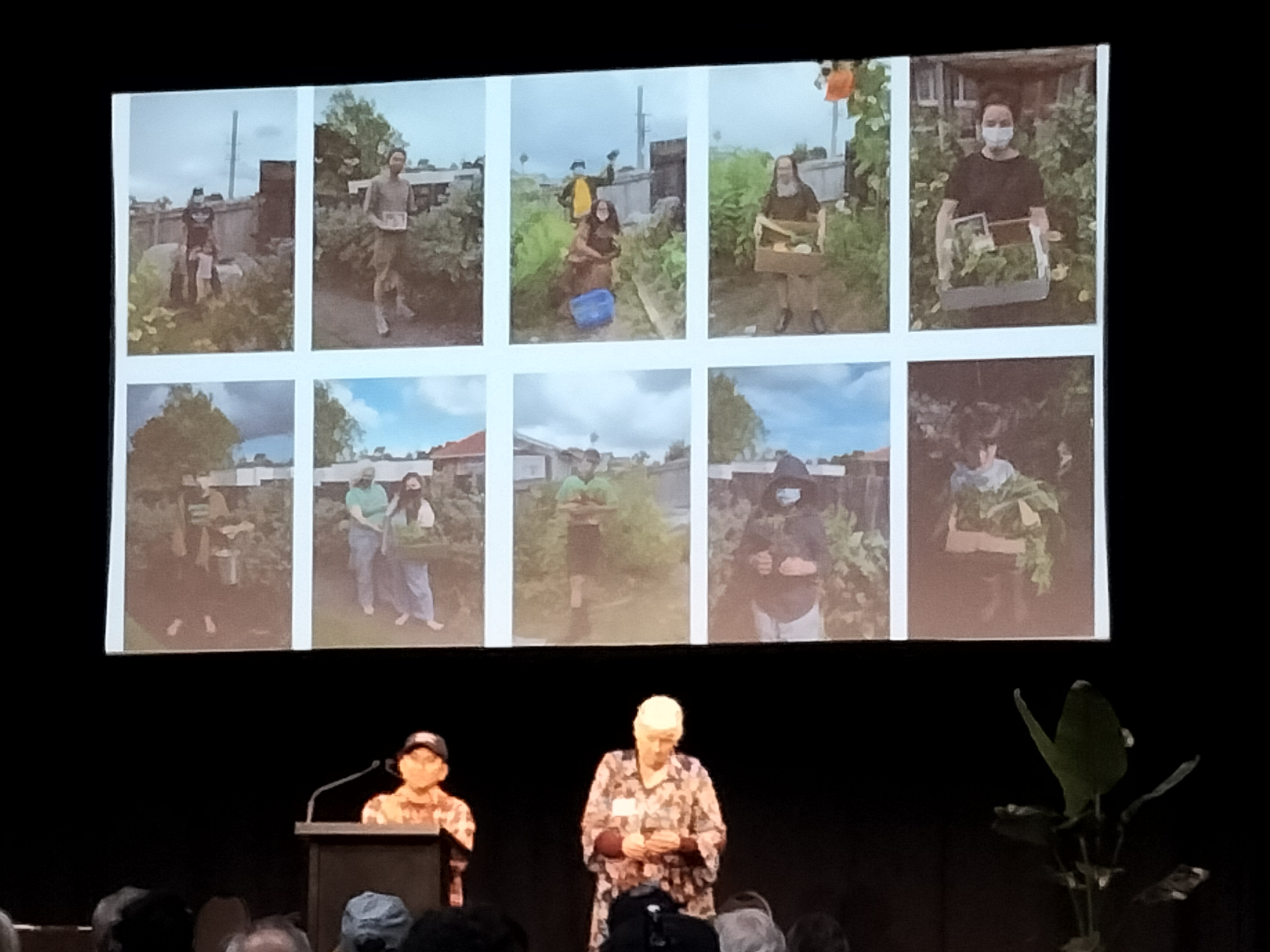
However, my favourite proposal came from Charles Buenconsejo . Like me an immigrant (me from Germany and Charles form the Philipines) he has developed the agroeclogoy based concept of backyard gardening. 80% of what he grows in his Whangarei garden he donates to the Food Rescue and the rest goes to his whanaua. He explained how to smartly use small garden space to build a healthy poly cropping environment. You can read up more about these principles on Charles https://www.soilofcultures.com/. He is also organizing back-to-the-roots for Asian communities to connect and share best practices from their culture. Charles explained that people in Whangarei are growing ocra, kumera, bananas and even tropical fruit like papaya , mango & pineapple.
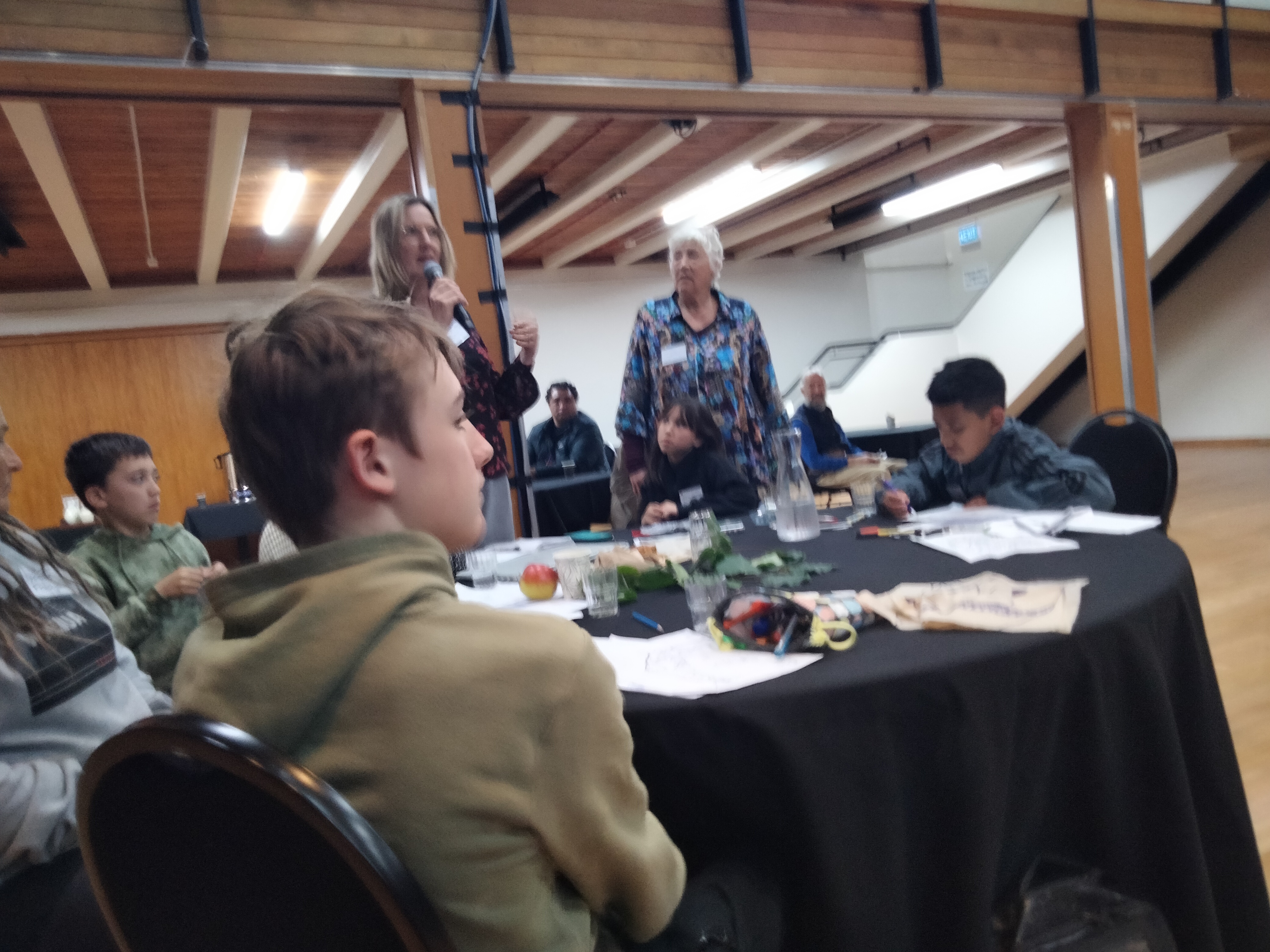
Catherine and Carol closed with a great ideation on where to from here. Those results will be shared on the official website no doubt, any time soon. Looking forward to an exciting second day today ….
Here a some of the Resources referenced : NOAA Carbon Tracker
Day 2: on 8. Sep 2023 we had several parallel workstreams going. I attended the following ones, starting with Ocean Regeneration by Glenn Edney, then NN interesting presentation on NZ’s decarbonization path according to EECA. However the most output oriented workshop was Nicole one on how to communicate on Climate Change with youth, community and tangata whenua.
The Ocean Regeneration workshop was well attended. I think all 12 pupil of Purua Primary School with teacher Suzie were there. They had great questions and wonderful contributions. We need more young talent to get involved.

Glenn Edney reported in detail on the amazing Tutukaka Kelp Forest restoration project. It was interesting to hear that kelp also like to grow up under the protection of more mature kelp or at least cuddle up with fellow young kelp. They use the Green Gravel approach to replant kelp. I found it fascinating that they tried biomimicry mussel based glue to re-attach the kelp. The first attempt failed, but they are further innovating to solve this problem. Apparently it costs between $2,000 – 20,000 to build a lab with lighting, refrigerating and several pools to grow kelp on land, before planting it in kina cleared ocean floor areas. Glenn will lead a site visit to Church Bay (Tutukaka Harbour) in Oct/ Nov 2023. Glenn also mentioned a project on Aotea (Great Barrier Island) where in Schooner Bay (Tryphena Harbour) he is assisting to fight the invasive caulerpa algae. Glenn referred to building relationships with Massey University and learning from Nick Sheares work in the Hauraki Gulf. Here is a link to the State of the Hauraki Gulf report and the wider Ahua Moana project. The call for action for this project is to volunteer with Glenn’s Ocean Spirit Trust to regrow kelp in the Tutukaka Harbour, help to recruit more tamaraki and other talent via social media, word of mouth and get wet to help.
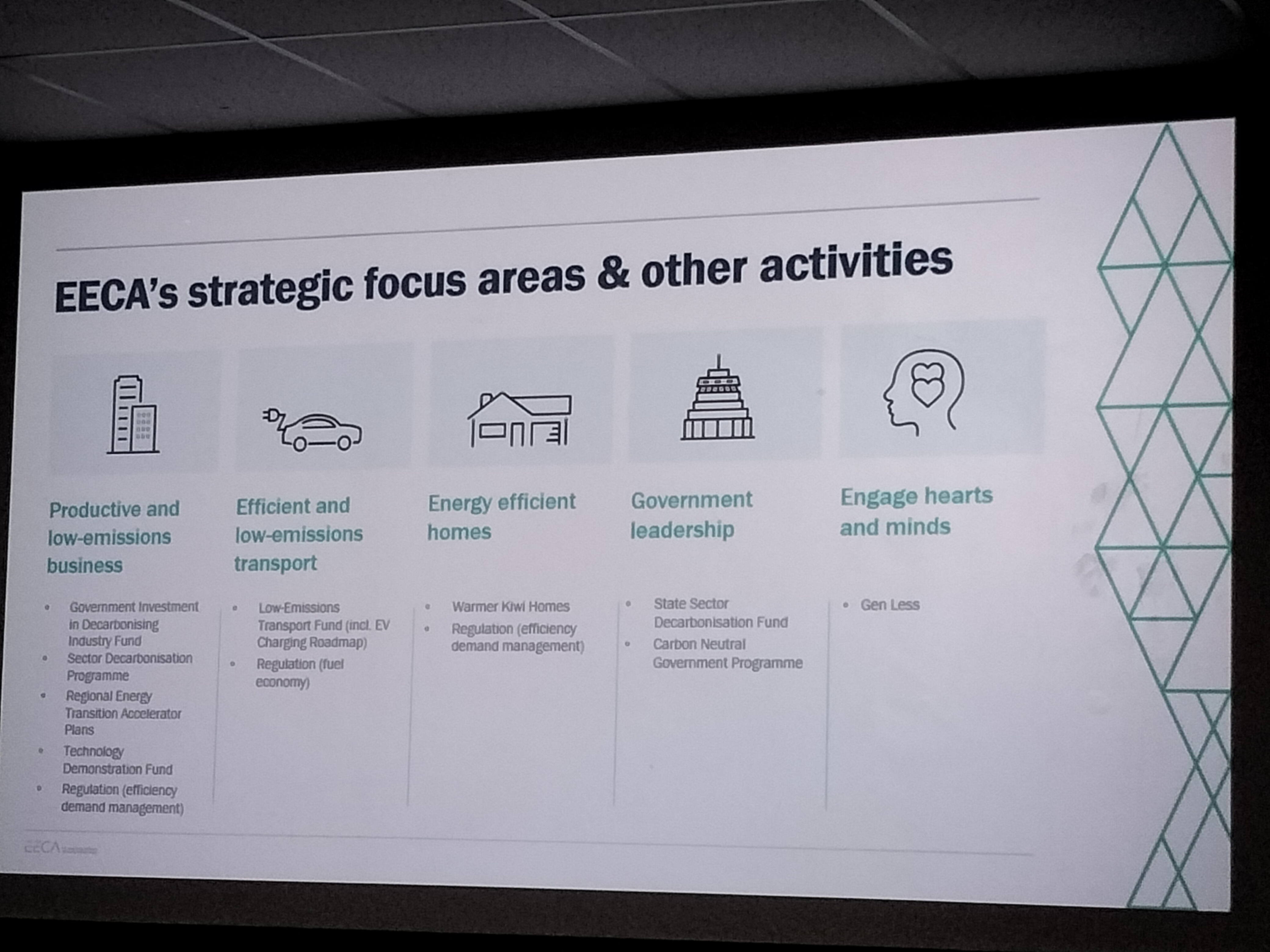
The next workshop I attended with from EECA in Auckland covered how small medium sized businesses in Tai Tokerau can join the decarbonization path. EECA has awesome support for local businesses. Joe Camuso, an avid EV evangelist, who runs NZ’s first electric vehicle taxi and a few electric charging stations, including one in Tutukaka, is one of these local SMEs contributing to this decarbonization. My technology business N3T is a virtual company from Day 1 in June 2016. We have seven talented workers in Whangarei, Auckland, Wellington, Queenstown, all working from home. My personal commute to work is about 10 seconds. Our key technology test lab for traffic monitoring is run from my front garden. Inge and Rolf talked about their amazing Carbon Calculator which is used by well over a thousand individuals and businesses in Tai Tokerau to determine their Carbon Footprint. NN reminded us that benchmarking, knowing how much carbon we produce today and compare it with our use in a week’s or month’s time gives input on how we should change our behaviour to be more carbon conscious. Raphael Poton from Ngtihine in Kawakawa works on wetland restoration projects and shared his insights on how we are currently very energy ineffiicent and how the Affco plant in Moorea is releasing toxic fumes at night and effuluent into the waterways. There is still a lot we have to do in Tai Tokearus. We also discussed the carbon footprint of Golden Bay Cement, still the biggest carbon emitter in the region and the Northland District Health Board as the biggest employer in the region, as well as two Fonterra Plants with a big carbon footprint. A lot of this can be read up in teh Regional Energy Transition Accelerator (RETA). The group also talked about the Ngawha Geothermal business park and the various solar farm projects in Tai Tokerau. As well as the Ruakaka Energy Park by Meridian Energy) which aims to build up to 200 MW capacity (enough to power up to 60,000 residential houses) near the old Refinery. Overall this small group had a great session and discussion with knowledgeable talent in the room.

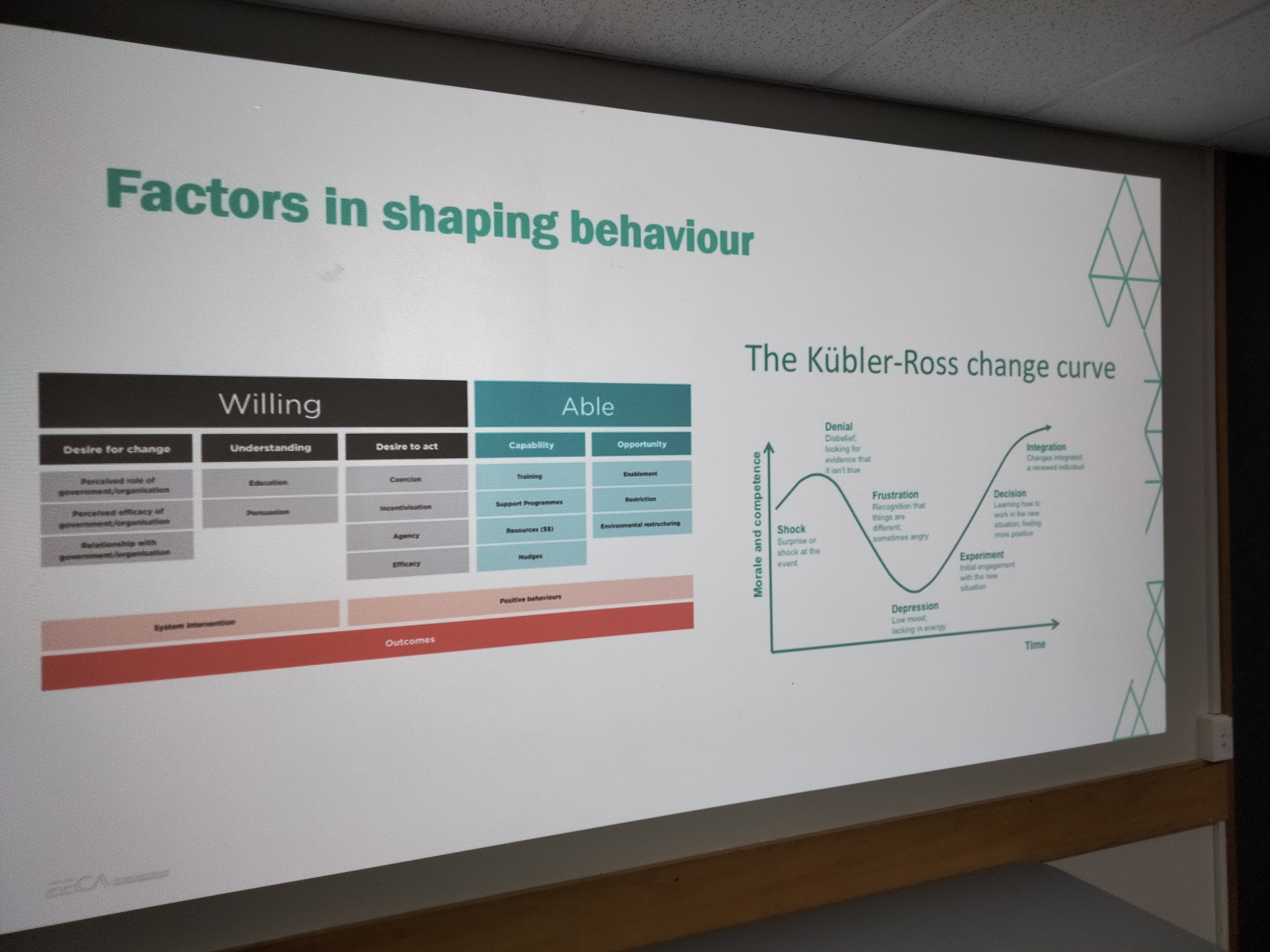
My favorites’ session of Day 2 was facilitated by Natalie Child, Climate Change lead from NRC. The full room brainstormed on how to best communicate with youth, community and tangata whenua on Climate Change. Our subgroup looked into how to communicate with “community”. Rakesh from NRC helped to document the groups lively discussion. We identified three target audiences: 1) the engaged (like those in the room) 2) the indifferent (sitting on the fence or not taking action) 3) the anti or deniers. We decided to ignore the latter group and not giving them a platform to share their bizarre views of the world. The excellent book “Merchant of Doubt” by the historian of science Oreske was recommended to learn from the methods of big tobacco and climate change deniers. To get to critical mass w need to get about 20% of the population to buy into and act. To achieve this we think targeting the “indifferent” and moving them to “engaged” is a promising strategy. But, how do we communicate the message and turn understanding and buy-in into tangible action? Natalie suggested the E.A.S.T. method, E easy , A attractive (make them feel good about it), S simple (break complex CC topic into small chunks which we can handle), T timely (act now, not tomorrow or the day after). Our brainstorming covered things like: promote positive stories (NZ: 4% GHG reductions since Carbon Act was introduced, Global: Earthshot‘s September’s Optimism Roundup ) , walk the talk, use your networks as a ripple effect to get to the required critical mass, make submissions to inform councils/ government, learn from awesome science communicators like NanoGirl, Neil de Grasse Tyson. climate change action is a human/ behavioral change challenge, positive story telling required (see visual meeting minutes, infographics…). The youth and tangata whenua group had very robust discussions as well, Nicole will document and share the summaries. Great session. Many thanks for the constructive discussions.
Back in the Plenary Catherine, Tania and Carol summarized some of the learnings and suggestions for the next Climate Change Action Conference in 2025. Most of us made a commitment to at least one action to start within the month. We will have a regroup in October to track progress and digest the rich interaction of this cool event. Please keep communicating and turn those into joint action and positive impact. Here is the closing waitata – Many thanks for reading my summary of the excellent event – Martin
 Northland Innovation Centre